

aWIP
aWIP is the genetic code from which everything else emerges. These are the raw, carbon-heavy, analog sketches created in notebooks where ideas are born, tested, refined, and documented. While most artists hide their sketches or discard them, the Continuum celebrates aWIP as essential, permanent, and exhibition-worthy.
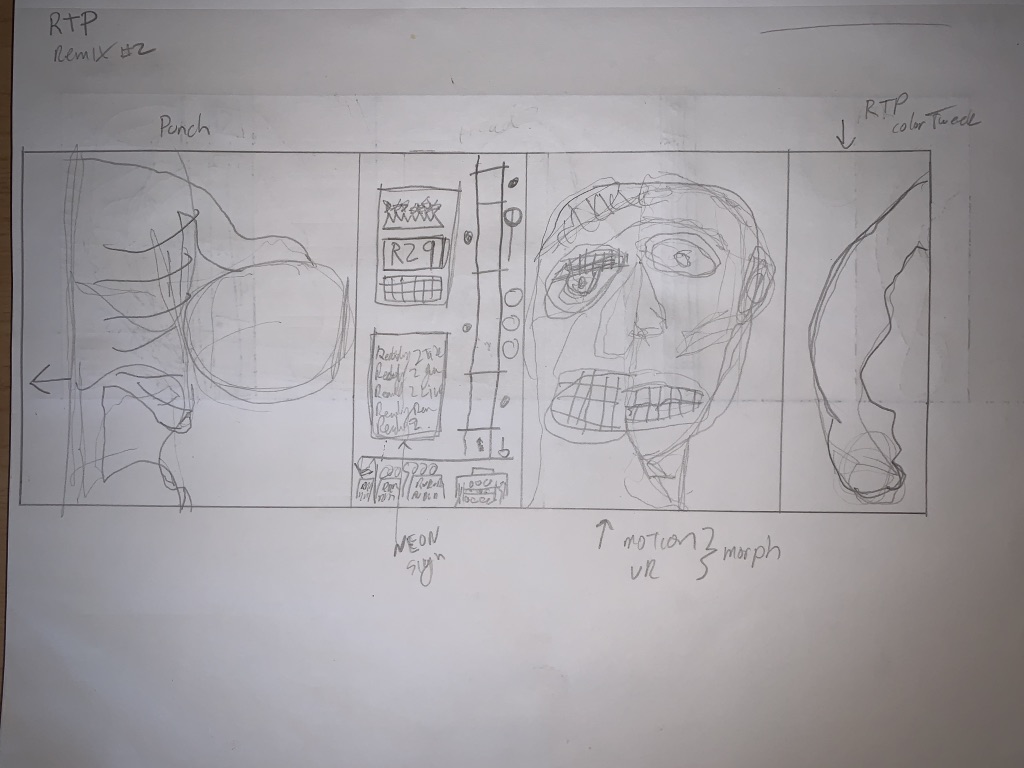
Continuum Type: aWIP
aWIP: BOXR RTP 1
Year: 2021
Why aWIP matters
In conventional art practice, the creative process follows a predictable arc: an artist makes dozens of sketches privately, selects one idea, executes it as a finished piece—and the sketches are discarded or stored away. The public only sees the polished result. The struggle is erased.
The AmbientStream Continuum inverts this. Every sketch is documented. Every iteration is cataloged, dated, and treated as primary source material. The aWIP phase is exhibited alongside later phases, showing the complete lineage. When VR worlds are created years later, the aWIP sketches document their authentic origin.
Transparency
In an era of AI-generated images and digital manipulation, aWIP proves human authorship. The physical artifacts—graphite on paper—can’t be faked retroactively.
Education
Viewers see that art comes from iteration, failure, and revision—not divine inspiration. The struggle is visible, teachable, and learnable.
Provenance
When DIMENSIONS environments are created years later, the aWIP sketches document their authentic origin. The lineage is unbroken from pencil to pixel.
Soul
Without aWIP, the DIMENSIONS phase would be hollow. The sketchbook provides the soul. Every virtual environment traces back to marks made by a hand holding a pencil.
The aWIP process
The process unfolds across four distinct sub-phases, each deepening the relationship between idea and form.
Ideation
Visual research and conceptual exploration. Anatomical reference through Bridgman’s structural anatomy studies, color theory research through Josef Albers, thematic development—boxing as metaphor, violence as system, body as documentation. Quick gesture studies testing poses, angles, and compositions. At this stage, sketches are loose, searching, often incomplete. Multiple ideas compete for attention.
Structural development
As ideas solidify, the focus shifts to anatomical accuracy and spatial relationships. Character definition establishes the distinct personalities of each sub-series—RTP, Champ, DFTC, OLKB, OB. Compositional architecture plans the triptych format. Annotation systems develop the text and data language that will appear in the paintings.
Technical planning
This is where aWIP reveals its true purpose. These aren’t just sketches—they’re blueprints for a multi-phase artwork that doesn’t exist yet. Color-coded layer mapping shows which elements will need to be separated in RE*MIX. Annotations like “this hand—isolate” and “background—separate layer” plan for extraction. Arrow notes previsualize potential rotation and movement for MOTION.
Final studies
Detailed anatomical drawings of key elements. Full-scale proportion tests. Color mixing samples. Typography studies. Compositional variations with self-critique notes. The artist creates annotated versions with instructions to their future self—messages across time that the later phases will answer.
What the pages show
aWIP pages intentionally carry the evidence of their making. Erasure marks hold the ghost images of rejected ideas. Overwrites layer new drawings on top of old ones. Corrections show crossed-out elements and redrawn sections. Handwritten annotations, arrows, labels, and self-critiques fill the margins. Smudges record the hand moving across the page. Edge damage—pages curled, torn, stained—prove real use over real time.
This isn’t messiness. It’s proof of genuine creative labor. And in an age when AI generates convincing images in seconds, that proof matters more than ever. AI can’t create years of iterative sketches with consistent handwriting. The physical artifacts can’t be faked retroactively. The evolution across pages shows human decision-making in its rawest form.
The struggle is not hidden. It is honored.