

ORIGINAL
The moment when months of sketches materialize as a physical, mixed-media painting on canvas. But this is not a traditional painting that exists solely to be framed and hung. This is a painting built with its own future deconstruction in mind—what Asher calls the source code for everything that follows.
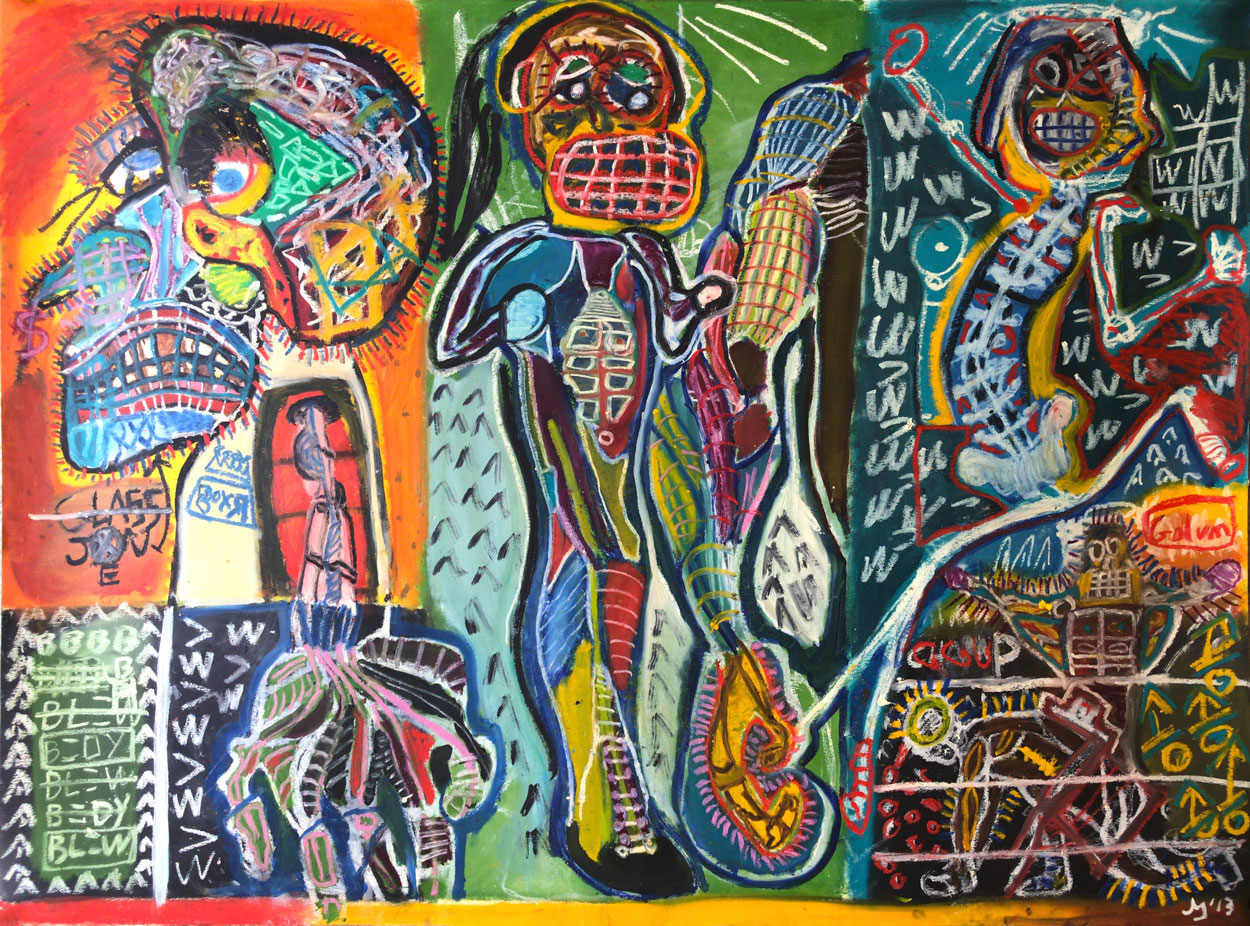
Category: Original
Title: BOXR Original
Materials: Oil Bar and Charcoal on watercolor paper
Year: 2013
Why the ORIGINAL matters
In an era obsessed with ephemeral digital assets, many contemporary artists create work that exists only on screens. This creates real problems: no physical provenance, no texture, no weight, and a collector base that’s still learning to trust the intangible.
By insisting on a physical ORIGINAL painting, the Continuum grounds the digital in something real. VR environments have a tangible source. The work has literal and figurative gravitas. Only one ORIGINAL exists—though later phases edition into multiples. Museums can preserve and conserve it. And the traditional art market understands what a painting is.
The ORIGINAL is the anchor that keeps the entire Continuum from floating away into pure digital abstraction.
Grounds the digital
Every RE*MIX print, MOTION animation, and DIMENSIONS environment traces back to this single physical object. It’s the proof that the digital was born from something you can touch.
Creates scarcity
Only one ORIGINAL exists per Continuum. It commands the highest value—the singular point of truth in an ecosystem of multiplied works.
Enables conservation
Physical artifacts can be preserved by museums for centuries. The ORIGINAL anchors the Continuum in art historical permanence.
Provides weight
Texture, smell, imperfection, scale—the qualities that software can never replicate. The ORIGINAL possesses presence that no screen can convey.
Strategic layering
Unlike traditional painters who build layers for aesthetic effect alone, Asher approaches the canvas like a topographic map maker or data storage system. Every layer is placed with the knowledge that it will eventually be isolated and extracted. The painting maintains visual separation between layers even while appearing unified—when scanned at high resolution, the layers can be distinguished and separated.
Background field layer
Atmospheric color washes and textured surfaces. In RE*MIX, these become the Stage—the environments where Actors exist.
Structural skeleton layer
Line drawings establishing figure placement, grid systems, and text positioning guides. The architectural framework of the composition.
Major figure layer
Primary anatomical forms in full color. In RE*MIX, these become the Actors—subjects that carry narrative weight and can exist independently.
Internal anatomy layer
Organs, bones, and muscle systems, color-coded for identification. Blue for lungs, yellow for digestive, red for heart—a visual language of the body’s interior.
Detail and accent layer
Secondary elements—gloves, bags, tools—and smaller anatomical studies. The supporting cast that enriches the primary subjects.
Text and data layer
Typography, numbers, annotations, fight statistics. Information that lives on the surface—readable, extractable, and designed for future isolation.
Atmosphere and mark layer
Final gestural marks, scratches, drips, and collage additions. In RE*MIX, these become Atmosphere—the textures and details that add life and complexity.
The ORIGINAL as translator
The ORIGINAL sits at the center of the Continuum, translating between every phase. It’s the Rosetta Stone—the key that allows translation between analog and digital, static and kinetic, framed and immersive.
Realizes ideas sketched in graphite, scales up from notebook to canvas, adds color to black-and-white studies. Every brushstroke answers a question the sketchbook asked.
Provides high-resolution source material, contains extractable layers, establishes the color palette for all future phases.
Elements painted to be isolated. Compositions designed with animation potential. The still image already contains its kinetic future.
Spatial relationships on flat canvas become actual three-dimensional space. Atmospheric backgrounds become immersive skies and walls.
The 32-megapixel scan
Once the ORIGINAL is complete, it undergoes high-resolution photography at 32 megapixels minimum. This captures every brushstroke, texture variation, color nuance, edge quality, and imperfection—enough data for large-scale printing, projection, and digital extraction.
There’s a productive paradox here: the higher the resolution of the scan, the more the ORIGINAL’s physical uniqueness is threatened by perfect digital copies. But simultaneously, the more valuable the physical ORIGINAL becomes—because it’s the only version with actual texture, smell, and weight. High-resolution documentation doesn’t replace the ORIGINAL. It proves why the ORIGINAL is irreplaceable.
The painting is not an end—it is a beginning. It’s source code, and source code is meant to be run.