
RE*MIX
The surgical moment when the ORIGINAL painting is digitally deconstructed into its component parts. This isn’t digitization—it’s liberation. Elements that coexisted on a single canvas are separated, isolated, and prepared for independent existence across multiple works, animations, and virtual environments.
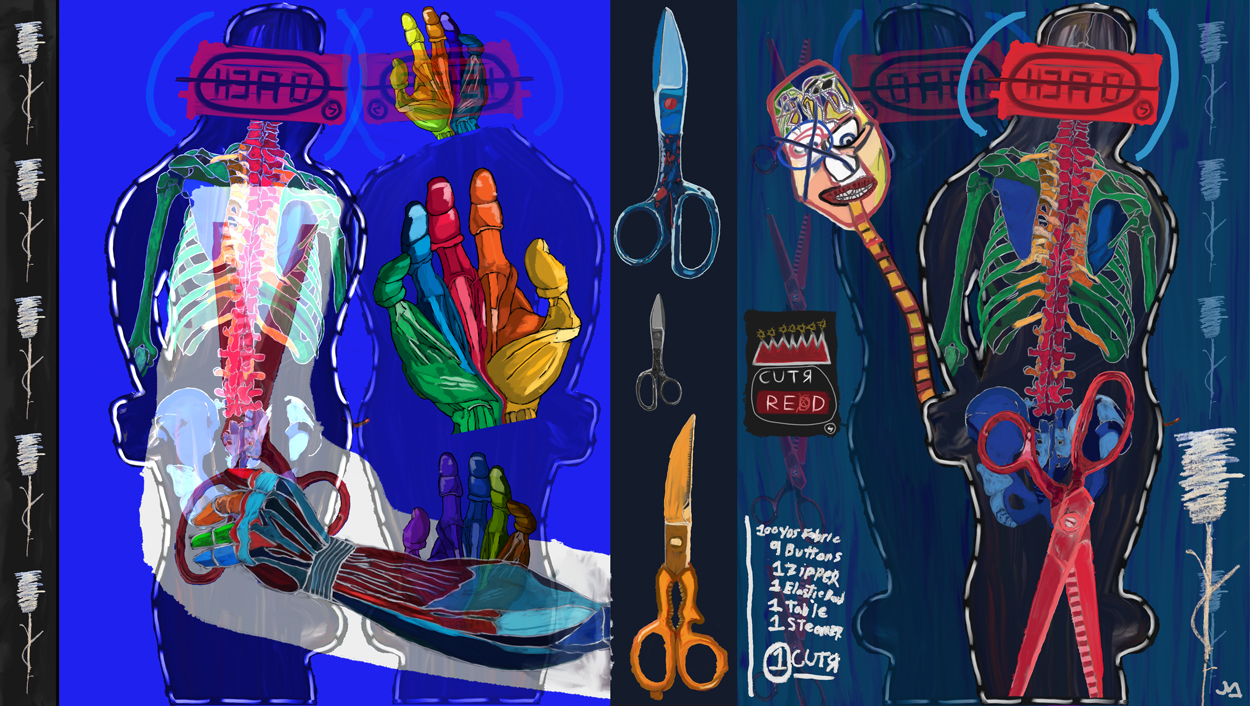
Category: RE*MIX
Title: CUTR RE*MIX 8
Medium: Digital Print & NFT
Size: 120 in. x 68 in.
Year: 2024
Why RE*MIX exists
Imagine a music producer sampling a vintage jazz record—not just playing it, but isolating the horn section, looping the drums, pitch-shifting the vocals. RE*MIX applies this logic to painting.
Traditional paintings are locked systems. All elements are permanently bonded to canvas, the composition is fixed forever, and nothing can be reconfigured or recontextualized. RE*MIX breaks that lock. Multiple narratives emerge from a single source. Elements become modular—recombined across infinite compositions. Specific organs, bones, and figures can be studied in isolation. And every extraction feeds forward into MOTION and DIMENSIONS.
RE*MIX transforms painting from monument to database. From fixed to fluid. From static to stream.
The three categories
In the RE*MIX philosophy, every painting contains three kinds of elements. Understanding this framework is the key to understanding how a single ORIGINAL becomes an entire ecosystem of works.
Actors
The primary subjects—figures, characters, and objects that command attention. Clear figure-ground separation, strong silhouettes, complete forms that carry narrative weight and can exist independently on any background. In BOXR: the central anatomical boxer figures, individual anatomical studies, the GOLUM creature, boxing equipment, and crown symbols.
Stage
The backgrounds, environments, and atmospheric fields where Actors exist. Usually flat or shallow depth, creating mood and context, providing color relationships and spatial tone. In BOXR: color field zones—orange, green, blue, dark—textured washes, and environmental marks.
Atmosphere
The marks, textures, and details that add life and complexity without being primary subjects. Small scale, often graphic or symbolic, adding information through text or visual interest through gesture. In BOXR: typography, grid patterns, measurement marks, drips, scratches, and gestural marks.
The five BOXR series
From one ORIGINAL BOXR painting, RE*MIX creates five distinct series—each with its own visual language, narrative focus, and emotional register.
RTP
Coiled energy and preparatory intensity. Full anatomical figures with internal organs visible, red punching bags as recurring motifs, skeletal arm studies, dark atmospheric backgrounds, and mathematical notations threading through the composition.
Champ
The duality of victory. Central figure with the distinctive grid-tooth jaw design, isolated anatomical hand, crown and halo symbols, body blow history columns. A mugshot aesthetic—documentation as portraiture.
DFTC
Layered, archaeological. The GOLUM figure with pink gloves, horizontal anatomical strip layers, transparent ghost figures suggesting memory, green archive panels, and medical annotations. Recovery as subject matter.
OLKB
Asymmetry celebrated. An anatomical figure that refuses balance, a flame-headed silhouette as recurring form, blueprint and technical drawing versions, and a body part inventory aesthetic—counting what remains.
OB
Retrospective and archival. Fractured, overlapping head studies that layer time. Film strip and contact sheet elements. Fight statistics as data visualization. The “OLD BOXR (7)” title card with flame crown. Slower, more contemplative compositions where transparency suggests the passage of time and the weight of memory.
Compositional strategies
RE*MIX compositions employ a consistent visual toolkit that creates coherence across the series while allowing each work its own identity.
Grid systems
Multi-panel layouts, vertical and horizontal strips, grid patterns that suggest data visualization and systematic thinking.
Scale play
Elements at dramatically different sizes—extreme close-ups alongside tiny repeated figures—creating tension between the intimate and the panoramic.
Color isolation
Sometimes only one element retains full color while everything else reduces to monochrome. Attention becomes surgical.
Transparency layers
Overlapping elements at different opacity levels. Ghost figures behind solid ones. Past and present exist simultaneously.
The painting is no longer a tombstone—it’s a seed. One source, infinite expressions.